Sea Savers - AR Climate Visualizer
An augmented reality experience that helps users visualize the impact of sea-level rise by connecting it to their daily lifestyle choices through interactive quiz-based AR.
The Challenge
Sea-level rise poses a serious threat to coastal cities and ecosystems worldwide, yet many young adults struggle to emotionally grasp its urgency. While climate change information is widely available, much of it is presented in abstract or data-heavy formats that fail to create personal relevance or motivate behavioral reflection. As a result, awareness does not consistently translate into engagement or action. How might we help young adults visualize the future impact of sea-level rise in a way that feels personal, engaging, and motivating rather than distant or overwhelming?
My Approach
Explored how interactive and playful digital experiences—particularly those native to social media—could help younger users better understand sea-level rise and reflect on how their everyday habits contribute to environmental impact. Through a 5-designer team collaboration (Team Cuties), we researched educational content from National Geographic and Verge Science, conducted lightning demos of related projects, and identified social media quiz filters as a powerful interaction pattern. Initially aimed to build with Spark AR but pivoted to p5.js due to technical limitations and documentation gaps. This pivot allowed us to simulate head-gesture interactions using machine-learning libraries while maintaining the intended interactive experience. Conducted two rounds of user testing to validate emotional impact, interaction clarity, and information retention.
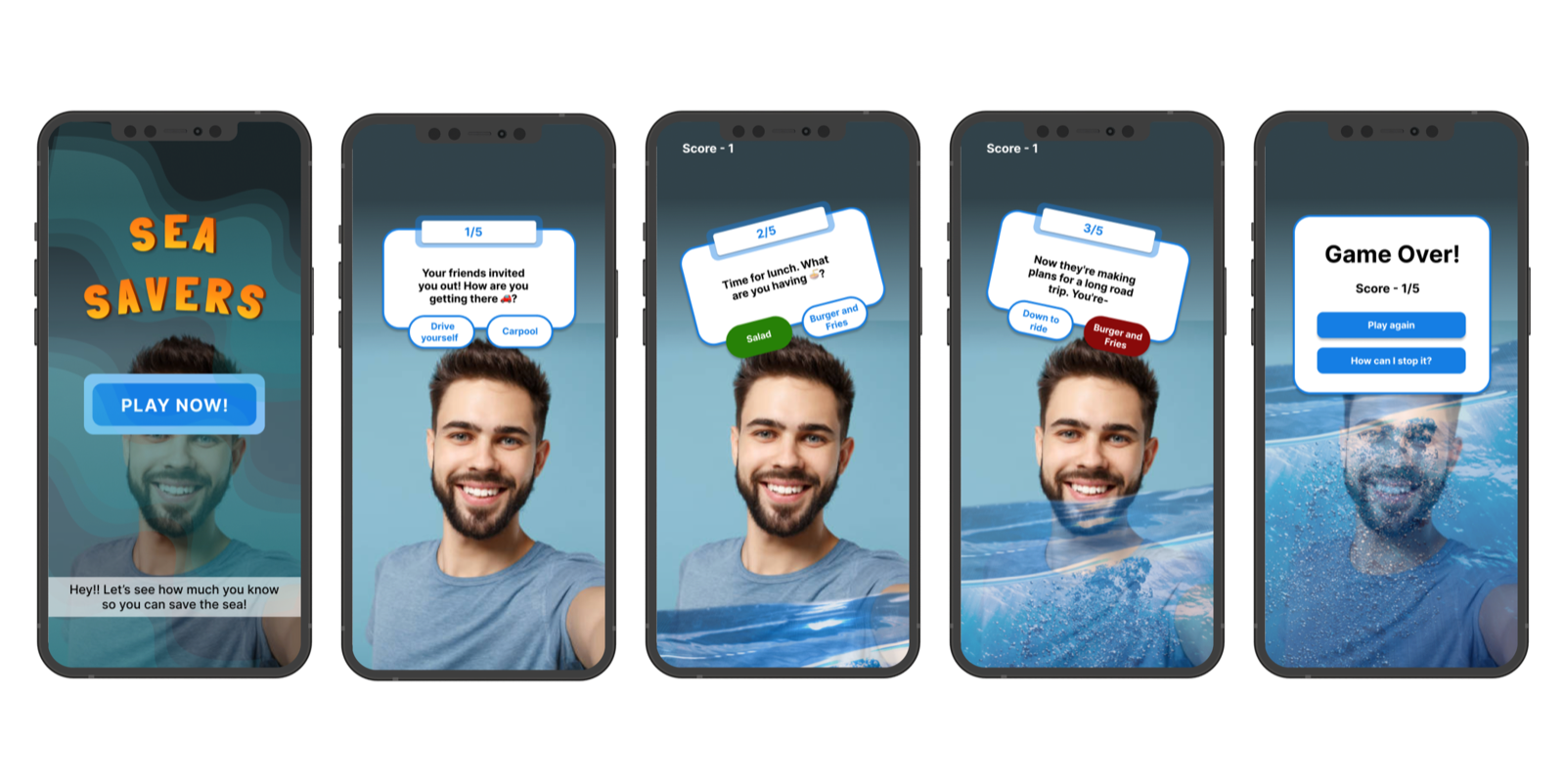
Interactive AR Prototype Flow
Complete user flow showing the AR quiz experience: intro screen with "Play Now" → quiz question with head-gesture selection → lifestyle choice feedback → progressive sea-level rise visualization → final "Game Over" screen showing full environmental impact. This demonstrates how users see the water level rise in real-time as they answer questions about their daily habits, creating an emotional connection to climate change through personalized AR visualization.
Outcome & Impact
Delivered a working AR-style prototype where users answer lifestyle-based questions and watch sea levels rise in real time around them. Approximately 75% of users reported increased awareness of sea-level rise after the experience. Users recalled more than 50% of daily habit impacts discussed in the quiz. Emotional visualization proved more effective than text-based explanation alone. The project successfully demonstrated how immersive, lightweight AR experiences can bridge the gap between climate awareness and emotional understanding—especially for younger, social-media-native audiences. Key insight: Visualization creates empathy faster than information alone.
AR Experience Demo
Pretotype demonstration testing how AR filters would be used in the Sea Savers climate experience. Users answer lifestyle questions through an interactive quiz interface and watch water levels rise in real-time, creating emotional connection to climate consequences. This p5.js pretotype validated the AR head-gesture interaction concept before full development.
Technical Details
Strategic Problem Reframing & Research
Initially explored broad climate topics before narrowing to sea-level rise as both urgent and difficult to visualize. Avoided assumptions by reflecting on our own understanding and supplementing with educational content from National Geographic and Verge Science. Defined three critical insights: (1) Emotional distance users feel from long-term climate impacts, (2) Need for experiential, visual learning, and (3) Target audience aligned with social media behaviors. Conducted lightning demos of related projects, revealing a recurring pattern: head-gesture quiz filters on Instagram and Snapchat were highly engaging for the target demographic. This research shaped the HMW question and interaction design direction.
Technical Pivot & Implementation
Original plan was to build an AR filter using Spark AR to leverage native social media distribution. However, encountered significant technical limitations: limited Spark AR documentation, complexity of simulating dynamic sea-level rise based on user input, and steep learning curve within a 2-month timeline with no budget. Made strategic pivot to p5.js, a JavaScript library the team had prior experience with. This allowed us to: simulate head-gesture interactions using machine-learning libraries, maintain the intended interactive experience, and rapidly iterate within our technical skill set. Pretotype demonstrated core interaction: as users answered questions, water level visibly rose around them. Technical constraints led to clearer focus on interaction design rather than platform distribution.
Iterative Testing & Refinement
Round 1 (Pretotype): Tested emotional understanding and visual clarity. Users understood the emotional intent immediately and rising water evoked strong reactions (guilt, concern, urgency). However, some users were confused about how to begin, and visuals felt 'too pretty,' reducing perceived threat. Changes: planned onboarding instructions, simplified UI icons, adjusted visual tone to increase tension. Round 2 (Web Prototype): Tested interaction clarity closer to real AR conditions. Head-shaking gestures were confusing without clear instructions, some users selected answers based on perceived 'correctness' rather than honesty, and end-screen information felt too generic and easy to ignore. Key insights: Interaction clarity is critical in AR, feedback needs to be immediate and contextual, and information delivery should feel actionable, not educational overload.
Lessons Learned
Visualization creates empathy faster than information alone—emotional engagement is critical for climate communication
Playful interactions can still communicate serious topics effectively without feeling frivolous
Clear onboarding is essential for experimental interfaces, especially in AR where visual cues are limited
Technical constraints can lead to better design decisions—pivot from Spark AR to p5.js forced focus on interaction quality
Social-media-native patterns (quiz filters, head gestures) lower adoption friction for younger audiences
Users respond more honestly when questions frame choices as 'your lifestyle' rather than 'correct answers'
End-screen content must be concise and actionable—users don't want long climate reports after an emotional experience
Hybrid experiences (AR-style web prototypes) can validate concepts before investing in native AR development
Collaboration across disciplines (UX, UI, content, technical) strengthens final outcome when roles are clearly defined
Testing in realistic contexts reveals interaction failures invisible in controlled environments
Senior-level insight: Behavioral design for climate action requires balancing urgency with hope—too much guilt demotivates
Key Features
- Quiz-based AR filter inspired by Instagram/Snapchat head-gesture interactions
- Real-time sea-level visualization responding to user choices
- Head-gesture controls simulated with ML libraries in p5.js
- Lifestyle questions connecting daily habits to environmental impact
- Emotional visual feedback designed to create urgency without overwhelm
- Social-media-native interaction patterns for younger audiences
- Lightweight web-based prototype for accessibility
- Progressive disclosure of climate information through interaction
- End-screen with contextual environmental insights
- Iteratively tested for clarity, emotional impact, and retention
Want to Collaborate?
I'm always interested in new experiments, research collaborations, and pushing the boundaries of AI design.