AI Restaurant Management SaaS
Designing a Human-Centered AI System for Inventory & Menu Decisions
Project Overview
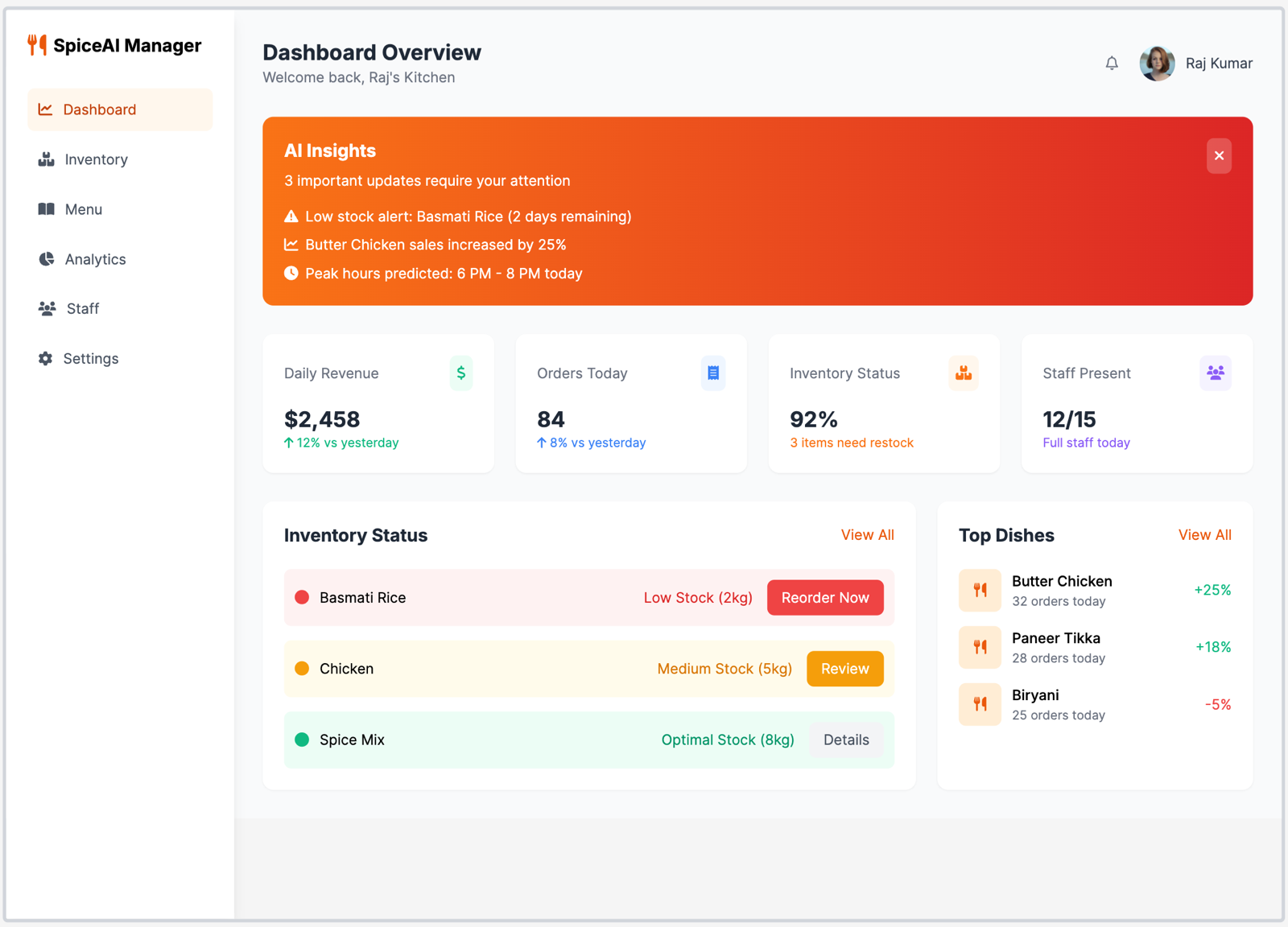
This project focused on designing an AI-powered restaurant management platform to support inventory planning, menu decisions, and purchasing workflows for small and mid-sized restaurants.
Although predictive models already existed within the organization, the real challenge was not improving accuracy. Restaurant managers were already surrounded by data. What they lacked was clarity at the moment of decision, especially when information was incomplete, time was limited, and mistakes were costly.
The goal of this project was to design a system where AI supports human judgment instead of replacing it, helping managers act with confidence rather than blindly trusting forecasts.
Context
This project shaped how the organization approaches human-in-the-loop AI across multiple internal products. The design patterns developed here became a foundation for other AI-driven features.
The Problem
Restaurant managers make daily decisions that directly affect profit and waste, often under uncertainty:
- How much inventory to order
- Which ingredients are at risk of expiring
- Whether to modify menus based on demand
Existing tools failed because they either:
Displayed raw analytics without guidance
Managers were left to interpret complex data on their own
Over-automated decisions
Systems made choices without accounting for local context
The Core Insight
Managers repeatedly expressed discomfort with systems that "decide for them." They wanted help - but they wanted to stay accountable.
Why AI Was the Right Solution
This was not a traditional dashboard problem.
AI was introduced because humans struggle to:
What AI Does Well
- Detect patterns across weeks of sales data
- Anticipate short-term demand shifts
- Balance inventory constraints with menu profitability
What Humans Do Better
- Understand supplier reliability
- Account for local events and intuition
- Exercise risk tolerance unique to each business
Design Principle: Intelligence Augmentation
Instead of asking "How can AI optimize inventory?", the team reframed the question:
"How can AI help managers make better decisions when the future is uncertain?"
This tension made it clear that AI alone was insufficient. The system had to be designed as a collaborative decision-support tool, where both human judgment and machine insight coexist.
Research & Insights
Methods
Key Insights
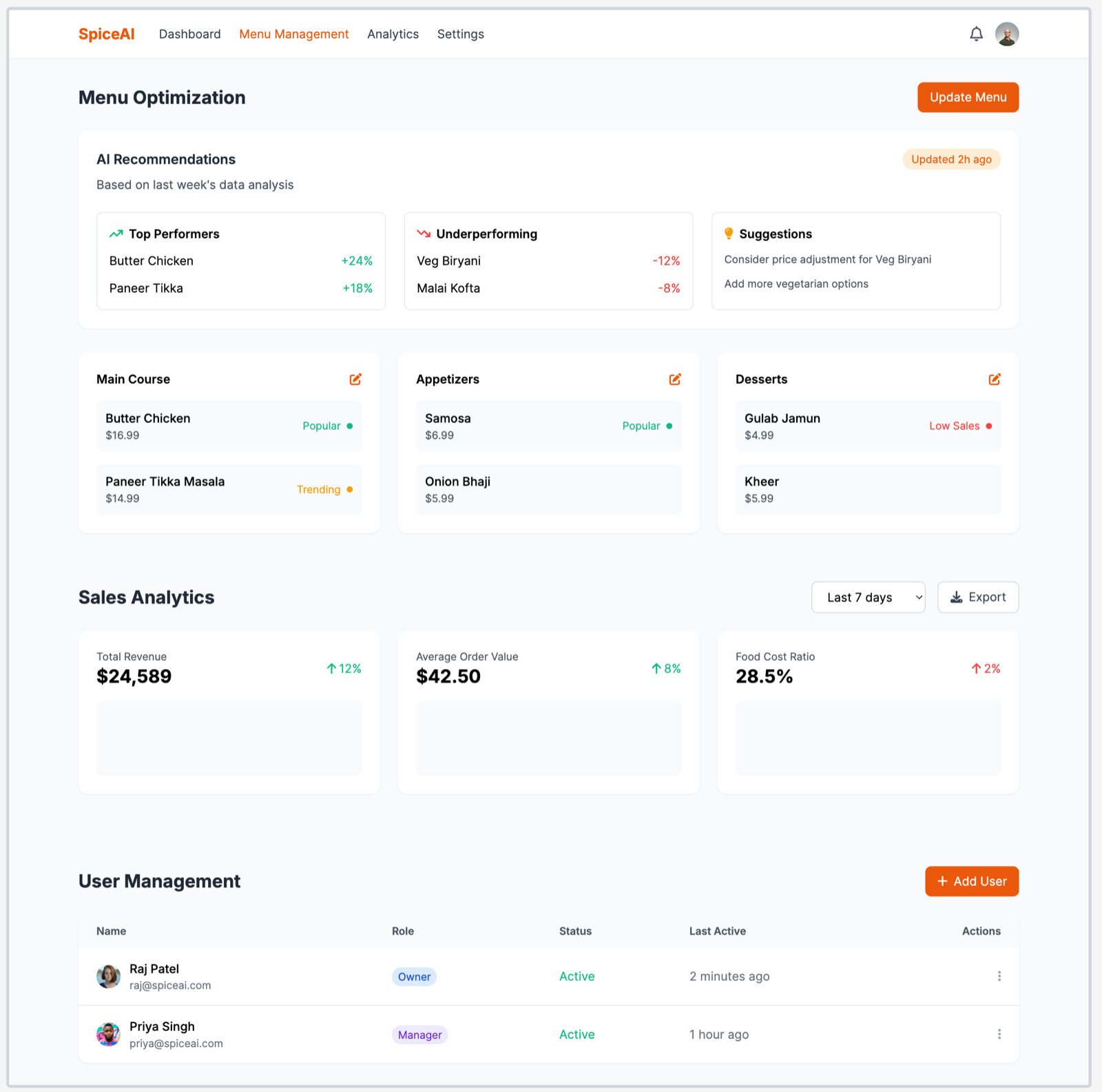
Trust calibration requires transparency, not just accuracy
Users need to maintain control and accountability
Managers need actionable insights, not complex dashboards
The ability to override AI actually increases adoption
These insights shaped both the interaction model and the tone of the interface.
Designing the Human-AI Handoff (The Seam)
The most important design challenge was making responsibility explicit.
Core Design Rule
The system may recommend. The human always decides.
This boundary is reinforced throughout the UI.
How the Handoff Is Made Explicit
Clear visual distinction between AI and user actions
Users can adjust quantities and parameters
Treated with equal importance to AI suggestions
Prevents accidental automation
This ensures users always know who is in control.
Trust Calibration by Design
Trust was not assumed - it was designed.
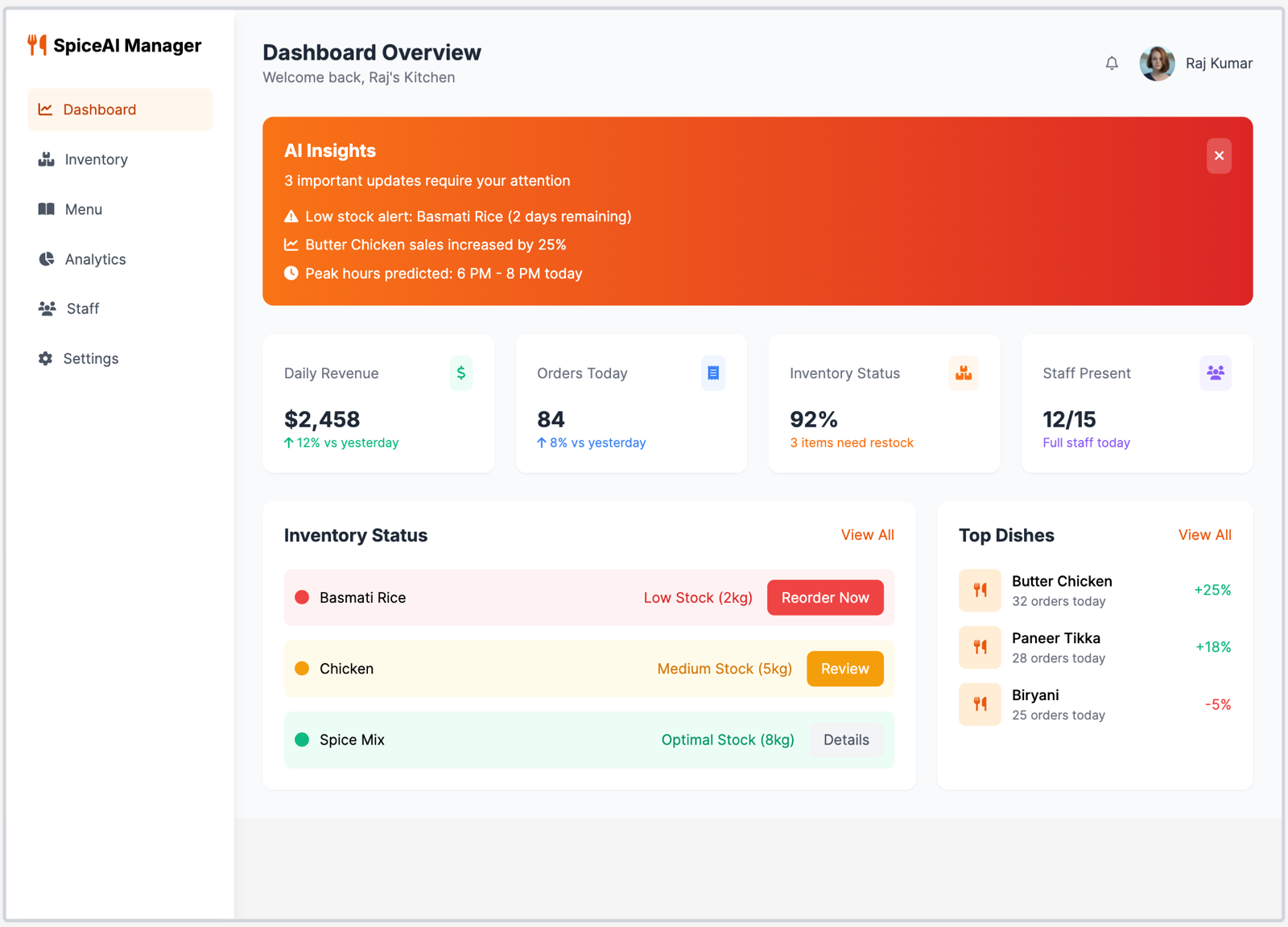
Prediction Confidence
Each recommendation includes a visible confidence indicator:
"High confidence - based on 14 days of sales data"
This helps users weigh suggestions instead of accepting them blindly.
Explainability Language
Instead of exposing models, the system explains inputs:
"This recommendation is based on recent demand and current inventory levels."
This aligns with how managers already reason about decisions.
Data Quality States
The system explicitly communicates uncertainty:
Silence implies certainty. Explicit gaps build credibility.
Designing for AI Failure
AI will inevitably be wrong. The interface was designed with this assumption.
When Predictions Are Wrong
- One-click undo
- Editable quantities
- Overrides retrain future recommendations
Preventing Over-Trust
- No auto-ordering
- No hidden automation
- Clear separation between forecast and action
Failure recovery was treated as a core interaction, not an edge case.
Example Scenario
On Monday morning, a manager opens the system.
"Order 4kg tomatoes (High confidence - based on 14-day trend)."
The manager knows a supplier delay is coming and adjusts the order to 2kg.
The system:
- Accepts the change
- Learns from the override
- Updates future recommendations
The outcome is collaboration, not correction.
Visual & Interaction Design Decisions
Progressive Disclosure
Reduce cognitive load by showing essential information first, with details on demand
Calm Color Palette
Avoid alarm fatigue with measured use of color to indicate urgency
Explanatory Microcopy
Context-sensitive tooltips that explain "why" at critical decision points
Clear Affordances
Obvious controls for editing and undoing actions to maintain user safety
These choices reinforce safety and control.
Outcomes & Impact
Quantitative Results
Strategic Impact
Design pattern reused across internal AI products
Established human-in-the-loop AI design standards for the organization
Created reusable components for AI explainability and trust calibration
Why This Isn't Just a Dashboard
Dashboards show data and expect interpretation.
This system:
- Highlights what matters now
- Explains why it matters
- Supports immediate, reversible action
The interface exists to mediate between AI output and human judgment, not to visualize data for its own sake.
Reflection
"AI does not fail because models are weak. It fails when responsibility is unclear."
By designing the human-AI seam, calibrating trust, and planning for failure, the system feels supportive rather than threatening.
Key Learnings
1. The "seam" is the most important design surface. The handoff between AI and human is where trust is built or broken. Making responsibility explicit through labeling, confirmation flows, and override affordances was critical to adoption.
2. Trust calibration requires exposing uncertainty. Confidence indicators and data quality warnings actually increased trust because they helped users understand when to rely on AI vs. their own judgment.
3. Designing for failure is designing for reality. AI will be wrong. Building undo, edit, and learning loops into the core experience, not treating them as edge cases, made users feel safe experimenting with the system.
4. Augmentation beats automation. Managers didn't want AI to make decisions for them. They wanted AI to surface patterns they couldn't see, explain its reasoning, and let them maintain control.
This Project Reinforced a Key Insight
AI UX success isn't about model accuracy - it's about designing the "seam" between AI and people. Every friction point we solved (lack of context, fear of error, uncertainty) mapped back to human cognition and trust - not technical failure.
More Case Studies
Multi-Platform Supply Chain Management System
Transforming forest produce supply chain from paper to unified digital ecosystem
Read Case StudyPanna Personality Assessment
Designing the human-AI seam for an AI-powered recruitment tool that automates personality assessments while earning trust through explainability and empathy
Read Case Study